
And Justice for All: Durham County Courthouse

At the opening of the new Durham County Courthouse in February 2013, a three-story mosaic image of Durham's 1916 courthouse was unveiled. The mosaic’s 265 unique photographs trace the concept of justice in Durham from the county's earliest days. They depict the people and institutions affiliated with the formal justice system, as well as those outside the system that played a part in the pursuit of justice. Photos illustrating the evolution of the neighborhood surrounding the courthouse are also featured. This site catalogs all the images in the mosaic.
Visitors entering the lobby of the new Durham County Courthouse see, on the right, a three-story, 48-by-30-foot image of the county’s second courthouse, a Neoclassical structure built in 1916. The image is created from 265 unique photographs that have been duplicated many times to create a collage of 6,500 postcard-size images.
The primary subject of the photos is justice in Durham County. The mural includes photos of judges, sheriffs, clerks of court, district attorneys, and others involved in the county’s justice system since its beginnings in 1881. Other photos depict images of justice beyond the courtroom, including those who fought for the rights of African-Americans, LGBTQ+ folks, women, and workers.
About the “And Justice for All” Web Exhibit
In July 2011, county manager Mike Ruffin called a meeting of representatives from Durham County government, the Durham County judicial system, O’Brien/Atkins Associates, PA (architects), and the community. The purpose of the meeting was to form a committee to select photographs that would form the individual components of a mural of the 1916 Durham County Courthouse. That mural would be installed in the lobby of the new courthouse. The Art Wall Committee, as it came to be known, carefully selected 265 photographs, most of which were chosen to depict the theme of justice in Durham County. The committee determined that viewers of the mural needed a way to learn about the individual photographs that it was made of, thus this web exhibit was born.
And Justice for All: Durham County Courthouse
At the opening of the new Durham County Courthouse in February 2013, a three-story mosaic image of Durham's 1916 courthouse was unveiled. The mosaic’s 265 unique photographs trace the concept of justice in Durham from the county's earliest days. They depict the people and institutions affiliated with the formal justice system, as well as those outside the system that played a part in the pursuit of justice. Photos illustrating the evolution of the neighborhood surrounding the courthouse are also featured. This site catalogs all the images in the mosaic.
Visitors entering the lobby of the new Durham County Courthouse see, on the right, a three-story, 48-by-30-foot image of the county’s second courthouse, a Neoclassical structure built in 1916. The image is created from 265 unique photographs that have been duplicated many times to create a collage of 6,500 postcard-size images.
The primary subject of the photos is justice in Durham County. The mural includes photos of judges, sheriffs, clerks of court, district attorneys, and others involved in the county’s justice system since its beginnings in 1881. Other photos depict images of justice beyond the courtroom, including those who fought for the rights of African-Americans, LGBTQ+ folks, women, and workers.
About the “And Justice for All” Web Exhibit
In July 2011, county manager Mike Ruffin called a meeting of representatives from Durham County government, the Durham County judicial system, O’Brien/Atkins Associates, PA (architects), and the community. The purpose of the meeting was to form a committee to select photographs that would form the individual components of a mural of the 1916 Durham County Courthouse. That mural would be installed in the lobby of the new courthouse. The Art Wall Committee, as it came to be known, carefully selected 265 photographs, most of which were chosen to depict the theme of justice in Durham County. The committee determined that viewers of the mural needed a way to learn about the individual photographs that it was made of, thus this web exhibit was born.
- Lori Neumeier, Intern, Durham County Library North Carolina Collection
-
- Lori compiled the exhibit content. She is a student in the joint School of Information and Library Science/Public Administration master’s program at the University of North Carolina at Chapel Hill. She worked long and hard to compile a tremendous amount of information. This exhibit could not have been completed without her.
- Lynn Richardson, NCC Librarian (2001-2016), Durham County Library North Carolina Collection
- Lynn curated the exhibit and edited the content.
- Hitoko Ueyama-Burke, Graphic Designer (2008-present), Durham County Library
- Hitoko produced the large image on the front page of the site.
- Matthew Clobridge, Library Webmaster (2012-2017), Durham County Library
- Matt designed and built the exhibit website.
- Shaina Leverett, NCC Librarian (2025)
- Migrated and updated exhibit website.
The Art Wall Committee
- Mike Andrews, Durham County sheriff
- Bob Ashley, Editor, Herald-Sun newspaper
- R. Kelly Bryant, Jr., Historian of Durham’s African-American Community
- E’Vonne Coleman-Cook, Chief Operating Officer, Durham Convention and Visitors Bureau
- Fred Hill, Deputy Clerk of Superior Court, District 14, Durham County
- Worth Hill, former Durham County Sheriff
- Tim Hillhouse, Architect, O’Brien/Atkins Associates, P.A.
- Kevin Montgomery, Principal and Director of Architecture, O’Brien/Atkins Associates, P.A.
- Rebekka Olsen, Assistant Public Defender, District 14, Durham County
- Lynn Richardson, Librarian, Durham County Library North Carolina Collection
- Ademola Shobande, Senior Project Manager, Durham County Engineering and Environmental Services Department
- Kathy Shuart, Trial Court Administrator, District 14, Durham County
- Archie Smith, Clerk of Superior Court, District 14, Durham County
- Glen Whisler, County Engineer, Durham County Engineering and Environmental Services Department
Exhibit credits
- Lori Neumeier, Intern, Durham County Library North Carolina Collection
-
- Lori compiled the exhibit content. She is a student in the joint School of Information and Library Science/Public Administration master’s program at the University of North Carolina at Chapel Hill. She worked long and hard to compile a tremendous amount of information. This exhibit could not have been completed without her.
- Lynn Richardson, NCC Librarian (2001-2016), Durham County Library North Carolina Collection
- Lynn curated the exhibit and edited the content.
- Hitoko Ueyama-Burke, Graphic Designer (2008-present), Durham County Library
- Hitoko produced the large image on the front page of the site.
- Matthew Clobridge, Library Webmaster (2012-2017), Durham County Library
- Matt designed and built the exhibit website.
- Shaina Leverett, NCC Librarian (2025)
- Migrated and updated exhibit website.
The Art Wall Committee
- Mike Andrews, Durham County sheriff
- Bob Ashley, Editor, Herald-Sun newspaper
- R. Kelly Bryant, Jr., Historian of Durham’s African-American Community
- E’Vonne Coleman-Cook, Chief Operating Officer, Durham Convention and Visitors Bureau
- Fred Hill, Deputy Clerk of Superior Court, District 14, Durham County
- Worth Hill, former Durham County Sheriff
- Tim Hillhouse, Architect, O’Brien/Atkins Associates, P.A.
- Kevin Montgomery, Principal and Director of Architecture, O’Brien/Atkins Associates, P.A.
- Rebekka Olsen, Assistant Public Defender, District 14, Durham County
- Lynn Richardson, Librarian, Durham County Library North Carolina Collection
- Ademola Shobande, Senior Project Manager, Durham County Engineering and Environmental Services Department
- Kathy Shuart, Trial Court Administrator, District 14, Durham County
- Archie Smith, Clerk of Superior Court, District 14, Durham County
- Glen Whisler, County Engineer, Durham County Engineering and Environmental Services Department
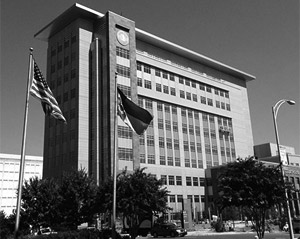 On March 31, 2010, ground was broken at the corner of Mangum and Dillard streets for Durham County’s fourth courthouse. The building was proposed in 1990 as a part of the Justice Center Master Plan, which specified a detention facility (completed in 1996), a 900-space parking garage, and the 318,533 square-foot courthouse. The courthouse , slated to cost $119 million, came in significantly under budget at $75 million. Architect for the new facility was O’Brien/Atkins Associates, P.A., and contractor was the Whiting-Turner Contracting Company, Inc. The building is part of the largest construction project ever overseen by the Durham County government.
The 11-story facility features 20 courtrooms, with the option to expand to 27 in the future. It has three distinct circulation systems, one for the public, a second for judges and other courthouse personnel, and a third for defendants staying in the jail. This feature of the design means that staff, the public, and jail inmates cross paths only in a courtroom. As an added security measure, jail inmates enter and leave the building through a secure, ground-floor connection with the detention facility.
In addition to space for district, superior, and other courts, the new facility houses the offices of the clerk of court, the magistrates, the district attorney and public defender, trial court administration, and the sheriff. Community Corrections, the Criminal Justice Resource Center, the Guardian Ad Litem program, and Juvenile Justice also have offices in the building.
LEED Certification
The building’s design achieves LEED (Leadership in Energy and Environmental Design) Gold certification, in accordance with the guidelines of the Durham County High Performance Building Policy the Durham County Board of Commissioners adopted in 2008. As a sign of the county’s commitment to improving energy efficiency, reducing waste, conserving water, and enhancing the health of its citizens and employees, all buildings with an area of more than 10,000 square feet are required to achieve a minimum LEED Gold rating, the second-highest LEED certification. The courthouse’s energy efficiency features include
- Green roof to reduce water runoff and insulate the building
- Energy-efficient lighting sensor system
- Rainwater collection cistern tank system
- Regionally sourced building materials
- Energy-efficient HVAC system
- Water-efficient landscaping and plumbing fixtures
- Priority parking for fuel-efficient vehicles
- Sustainable harvested wood used throughout the interior
- Bike lockers and shower facilities for employees
The new Durham County Courthouse joins North, South, and East regional libraries, the Southwest Library addition, the Durham County Animal Control Building, the Criminal Justice Resource Center, the Triangle Wastewater Treatment Plant Administration Building, and the Human Services Complex as LEED-certified buildings built by the county.
The completed courthouse is a prominent feature of the downtown skyline. County manager Mike Ruffin said of the building, “It will be very recognizable from [Highway] 147. People will be very proud of it.”
The Courthouse
On March 31, 2010, ground was broken at the corner of Mangum and Dillard streets for Durham County’s fourth courthouse. The building was proposed in 1990 as a part of the Justice Center Master Plan, which specified a detention facility (completed in 1996), a 900-space parking garage, and the 318,533 square-foot courthouse. The courthouse , slated to cost $119 million, came in significantly under budget at $75 million. Architect for the new facility was O’Brien/Atkins Associates, P.A., and contractor was the Whiting-Turner Contracting Company, Inc. The building is part of the largest construction project ever overseen by the Durham County government.
The 11-story facility features 20 courtrooms, with the option to expand to 27 in the future. It has three distinct circulation systems, one for the public, a second for judges and other courthouse personnel, and a third for defendants staying in the jail. This feature of the design means that staff, the public, and jail inmates cross paths only in a courtroom. As an added security measure, jail inmates enter and leave the building through a secure, ground-floor connection with the detention facility.
In addition to space for district, superior, and other courts, the new facility houses the offices of the clerk of court, the magistrates, the district attorney and public defender, trial court administration, and the sheriff. Community Corrections, the Criminal Justice Resource Center, the Guardian Ad Litem program, and Juvenile Justice also have offices in the building.
LEED Certification
The building’s design achieves LEED (Leadership in Energy and Environmental Design) Gold certification, in accordance with the guidelines of the Durham County High Performance Building Policy the Durham County Board of Commissioners adopted in 2008. As a sign of the county’s commitment to improving energy efficiency, reducing waste, conserving water, and enhancing the health of its citizens and employees, all buildings with an area of more than 10,000 square feet are required to achieve a minimum LEED Gold rating, the second-highest LEED certification. The courthouse’s energy efficiency features include
- Green roof to reduce water runoff and insulate the building
- Energy-efficient lighting sensor system
- Rainwater collection cistern tank system
- Regionally sourced building materials
- Energy-efficient HVAC system
- Water-efficient landscaping and plumbing fixtures
- Priority parking for fuel-efficient vehicles
- Sustainable harvested wood used throughout the interior
- Bike lockers and shower facilities for employees
The new Durham County Courthouse joins North, South, and East regional libraries, the Southwest Library addition, the Durham County Animal Control Building, the Criminal Justice Resource Center, the Triangle Wastewater Treatment Plant Administration Building, and the Human Services Complex as LEED-certified buildings built by the county.
The completed courthouse is a prominent feature of the downtown skyline. County manager Mike Ruffin said of the building, “It will be very recognizable from [Highway] 147. People will be very proud of it.”
Many resources were consulted in gathering information for this web exhibit. The primary ones are listed here.
Books
- Anderson, Jean Bradley. Durham County: A History of Durham County, North Carolina. Durham, NC: Duke University Press, 2011.
- Andrews, Robert McCants. John Merrick: A Biographical Sketch. Durham, NC: Press of the Seeman Printery, 1920.
- Bolich, W. Bryan. Duke Law School Alumni Directory, 1868-1972: With a History of Duke Law School. Durham, NC: Duke Law School and the Duke Law Alumni Association, 1972.
- Covington, Howard E. Jr., and Marion E. Ellis, ed. The North Carolina Century: Tar Heels Who Made a Difference, 1900-2000. Chapel Hill, NC: University of North Carolina Press, 2002.
- Davidson, Osha Gray. The Best of Enemies: Race and Redemption in the New South. New York: Scribner, 2007.
- Dixon, Wyatt. How Times Do Change: A Series of Sketches of Durham and Her Citizens. Durham, NC: Central Carolina Pub., 1987.
- Durham County N.C. Sheriff’s Department, 1881-1981. Durham, NC: Durham County Sheriff’s Department, 1981.
- Durham Police Department, Durham, North Carolina: Proudly Serving Our Community. Durham, NC: Durham Police Department, 1992.
- The History of the Durham Fire Department, 1872-1995. Durham, NC: Durham Fire Fighters Association, 1995.
- McKissick-Melton, Charmaine, Ph.D. “Joycelyn D. McKissick: Narrative of a Civil Rights Soldier,” Paper presented at the annual meeting of the 34th Annual National Council for Black Studies, Sheraton New Orleans Hotel, New Orleans, LA, March 17, 2010.
- Murray, Pauli. Proud Shoes: The Story of an American Family. New York: Harper & Row, 1978.
- Powell, William S., ed. Dictionary of North Carolina Biography. Chapel Hill, NC: University of North Carolina Press, 1979.
- Soaring on the Legacy: A Concise History of North Carolina Central University, 1910-2010. Durham NC: North Carolina Central University, 2010.
- So Far: 70th Anniversary. Durham, NC: North Carolina Central University School of Law, 2009.
- Strong, Lisa Gayle. The American Red Cross in Durham, North Carolina: A Historical Overview from 1917-1992, Commemorating the 75th Anniversary of the Central North Carolina Chapter. Durham, NC: American Red Cross Durham County Chapter, 1992.
- Thompson, Marshall.Hayti Police: Memoirs of a Former Durham Police Officer. Durham, NC: Plaza Printers, 1997.
- Weare, Walter B. Black Business in the New South: A Social History of the North Carolina Mutual Life Insurance Company. Urbana: University of Illinois Press, 1993.
- Webb, Mena. The Way We Were: Remembering Durham. Durham, NC: Historic Preservation Society of Durham, 2007.
Court Cases
- Blue v. Durham Public School District, 95 F. Supp. 441 (Middle District NC, 1951).
- Wheeler v. Durham City Board of Education, 309 F.2d 630 (4th Circuit, 1962).
Film
- Negro Durham Marches On. Produced by the Durham Business and Professional Chain. Durham, NC: 1948.
Periodicals
- Alumni Directory: the University of North Carolina. Chapel Hill, NC: General Alumni Association, the University of North Carolina.
- The Carolina Times. Durham, NC.
- The Chronicle: The Independent Daily at Duke University. Durham, NC. www.dukechronicle.com.
- County Lines. Raleigh, NC: North Carolina Association of County Commissioners.
- The Daily Record. Ellensburg, WA. ww.dailyrecord.com.
- Duke Directory, Class of… . Durham, NC: General Alumni Association, Duke University.
- Duke University Libraries Magazine. Durham, NC. www.blogs.library.duke.edu/magazine.
- Duke Today. Durham, NC. today.duke.edu.
- The Durham Morning Herald. Durham, NC.
- The Durham News. Durham, NC. www.thedurhamnews.com.
- The Durham Sun. Durham, NC.
- The Forum. Washington, DC: National Forum for Black Public Administrators.
- The Herald-Sun. Durham, NC. www.heraldsun.com.
- The Independent Weekly. Durham, NC. www.indyweek.com.
- Lambda. Chapel Hill, NC: University of North Carolina at Chapel Hill: Carolina Gay and Lesbian Association.
- The Martindale-Hubbell Law Directory. New York: Martindale-Hubbell Law Directory, Inc.
- The Morning Star. Wilmington, NC.
- The News & Observer. Raleigh, NC. www.newsobserver.com.
- The News & Record. Greensboro, NC. www.news-record.com.
- The New York Times. New York, NY.
- The North Carolina Anvil. Durham, NC.
- North Carolina State Bar Quarterly
Raleigh, NC.
- The Pinnacle News Paper. NC.
- The Spartanburg Herald-Journal. Spartanburg, SC.
- The Whetstone. Durham, NC: North Carolina Mutual Life Insurance Company.
Websites
- 2012 North Carolina Voter Guide. A service of UNC-TV and North Carolina Center for Voter Education. www.ncvoterguide.org.
- 3D U.S. Infantry Regiment (The Old Guard). www.army.mil/info/organization/unitsandcommands/commandstructure/theoldguard.
- ABC11-WTVD: Raleigh News, Weather, Sports, and Traffic. www.abclocal.go.com/wtvd/index.
- ABC News: Breaking News, Latest News, & Top Video News. www.abcnews.com.
- American Association of State Colleges and Universities. www.aascu.org.
- The Black Past: Remembered and Reclaimed. www.blackpast.org.
- Biographical Directory of the United States Congress: 1774-present. www.bioguide.congress.gov.
- “The Bull City— A Short History of Durham, North Carolina.” Durham, NC: Durham County library North Carolina Collection Presentation based on
- Anderson, Jean Bradley. Durham County: A History of Durham County, North Carolina. . www.durhamcountylibrary.org/ncc/short_history.pdf.
- The Carolina Story: A Virtual Museum of University History. www.museum.unc.edu.
- “Celebrating D. W. Newsom: Durham’s First County Manager.” Durham County Library North Carolina Collection Exhibit. www.durhamcountylibrary.org/ncc/newsom/index.php.
- City of Durham. www.durhamnc.gov.
- Civil Rights Digital Library. www.crdl.usg.edu.
- Clinton Foundation. www.clintonfoundation.org.
- CORE: Congress of Racial Equality. www.core-online.org.
- David M. Rubenstein Rare Book and Manuscript Library. www.library.duke.edu/rubenstein/about/visit.html.
- Davis, Kevin. Bull City Rising. www.bullcityrising.com.
- Documenting the American South. www.docsouth.unc.edu/.
- Duke University Archives. www.library.duke.edu/uarchives.
- Duke University School of Law. www.law.duke.edu.
- “Durham Civil Rights Heritage Project.” Durham County Library North Carolina Collection Exhibit.www.durhamcountylibrary.org/dcrhp/index.php.
- Durham County Government: The Official Website. www.co.durham.nc.us.
- Durham County Library North Carolina Collection. www.durhamcountylibrary.org/ncc.php.
- Durham County NC: Thrive. www.dconc.gov.
- Durham Convention & Visitors Bureau. www.durham-nc.com/.
- Durham, NC: Official Visitor Information Site for Durham, NC. www.durham-nc.us.
- Durham Police Department 2011 Annual Report. Durham, NC: Durham Police Department, 2011. www.durhamnc.gov/ich/op/DPD/Documents/AnnualReportFinal.pdf.
- Global Nonviolent Action Database. www.nvdatabase.swarthmore.edu.
- Hargett Funeral Service, Inc. www.hargettfuneralserviceinc.com.
- The Hayti Project. www.haytitheheritage.com/wordpress.
- History of the Durham County Library and the Stanford L. Warren Library. www.durhamcountylibrary.org/news/pr/DCL_History.pdf.
- “The History of Public Library Service in Durham, North Carolina, 1897 to 1997.” Durham County Library North Carolina Collection Exhibit. http://www.durhamcountylibrary.org/ncc/dclhistory.php.
- International Association of Official Human Rights Agencies. www.iaohra.org.
- Judge Jim Hardin, Superior Court Judge. www.judgejimhardin.com.
- Kueber, Gary. Open Durham. www.opendurham.org.
- Museum of Durham History. www.museumofdurhamhistory.org.
- National Bar Association. www.nationalbar.org.
- National Governors Association. www.nga.org.
- National Park Service. www.nps.gov.
- North Carolina Central University, James E. Shepard Memorial Library University Archives, Records, and History. www.web.nccu.edu/shepardlibrary/about/dept_archives.html.
- The North Carolina Court System. www.nccourts.org.
- North Carolina History Project. www.northcarolinahistory.org.
- North Carolina Museum of History. www.ncmuseumofhistory.org/.
- North Carolina Pride: North Carolina’s Annual Gay, Lesbian, Bisexual, and Transgendered Festival. www.ncpride.org.
- North Carolina State Education Assistance Authority. www.ncseaa.edu.
- North Carolina State Ethics Commission. www.test.ethicscommission.nc.gov.
- The North Carolina Writers’ Network. www.ncwriters.org.
- NCPedia. www.ncpedia.com.
- Office of the North Carolina Appellate Reporter. www.aoc.state.nc.us/www/public/html/ARHome.asp.
- Officer Down Memorial Page: Remembering All of Law Enforcement’s Heroes. www.odmp.org.
- Old West Durham Neighborhood Association. www.owdna.org.
- Pauli Murray Project. www.paulimurrayproject.org.
- Re-Elect Durham County Commissioner Brenda Howerton. www.brendahowerton.com.
- Southern Historical Collection at Wilson Library. www.lib.unc.edu/mss/shc.
- University of North Carolina News. www.uncnews.unc.edu.
- UNC-TV Online: North Carolina’s Statewide Television Network. www.unctv.org.
- Vaddrick Q. Parker Law Firm. www.vaddrick.com
- “The Women Who Ran the Schools: The Jeanes Teachers and Durham County’s Rural Black Schools.” Durham County Library North Carolina Collection Exhibit. www.durhamcountylibrary.org/ncc/jeanes/index.php.
- WRAL: Raleigh News, Weather, Triangle Traffic, and NC Lottery. www.WRAL.com.
Exhibit Resources
Many resources were consulted in gathering information for this web exhibit. The primary ones are listed here.
Books
- Anderson, Jean Bradley. Durham County: A History of Durham County, North Carolina. Durham, NC: Duke University Press, 2011.
- Andrews, Robert McCants. John Merrick: A Biographical Sketch. Durham, NC: Press of the Seeman Printery, 1920.
- Bolich, W. Bryan. Duke Law School Alumni Directory, 1868-1972: With a History of Duke Law School. Durham, NC: Duke Law School and the Duke Law Alumni Association, 1972.
- Covington, Howard E. Jr., and Marion E. Ellis, ed. The North Carolina Century: Tar Heels Who Made a Difference, 1900-2000. Chapel Hill, NC: University of North Carolina Press, 2002.
- Davidson, Osha Gray. The Best of Enemies: Race and Redemption in the New South. New York: Scribner, 2007.
- Dixon, Wyatt. How Times Do Change: A Series of Sketches of Durham and Her Citizens. Durham, NC: Central Carolina Pub., 1987.
- Durham County N.C. Sheriff’s Department, 1881-1981. Durham, NC: Durham County Sheriff’s Department, 1981.
- Durham Police Department, Durham, North Carolina: Proudly Serving Our Community. Durham, NC: Durham Police Department, 1992.
- The History of the Durham Fire Department, 1872-1995. Durham, NC: Durham Fire Fighters Association, 1995.
- McKissick-Melton, Charmaine, Ph.D. “Joycelyn D. McKissick: Narrative of a Civil Rights Soldier,” Paper presented at the annual meeting of the 34th Annual National Council for Black Studies, Sheraton New Orleans Hotel, New Orleans, LA, March 17, 2010.
- Murray, Pauli. Proud Shoes: The Story of an American Family. New York: Harper & Row, 1978.
- Powell, William S., ed. Dictionary of North Carolina Biography. Chapel Hill, NC: University of North Carolina Press, 1979.
- Soaring on the Legacy: A Concise History of North Carolina Central University, 1910-2010. Durham NC: North Carolina Central University, 2010.
- So Far: 70th Anniversary. Durham, NC: North Carolina Central University School of Law, 2009.
- Strong, Lisa Gayle. The American Red Cross in Durham, North Carolina: A Historical Overview from 1917-1992, Commemorating the 75th Anniversary of the Central North Carolina Chapter. Durham, NC: American Red Cross Durham County Chapter, 1992.
- Thompson, Marshall.Hayti Police: Memoirs of a Former Durham Police Officer. Durham, NC: Plaza Printers, 1997.
- Weare, Walter B. Black Business in the New South: A Social History of the North Carolina Mutual Life Insurance Company. Urbana: University of Illinois Press, 1993.
- Webb, Mena. The Way We Were: Remembering Durham. Durham, NC: Historic Preservation Society of Durham, 2007.
Court Cases
- Blue v. Durham Public School District, 95 F. Supp. 441 (Middle District NC, 1951).
- Wheeler v. Durham City Board of Education, 309 F.2d 630 (4th Circuit, 1962).
Film
- Negro Durham Marches On. Produced by the Durham Business and Professional Chain. Durham, NC: 1948.
Periodicals
- Alumni Directory: the University of North Carolina. Chapel Hill, NC: General Alumni Association, the University of North Carolina.
- The Carolina Times. Durham, NC.
- The Chronicle: The Independent Daily at Duke University. Durham, NC. www.dukechronicle.com.
- County Lines. Raleigh, NC: North Carolina Association of County Commissioners.
- The Daily Record. Ellensburg, WA. ww.dailyrecord.com.
- Duke Directory, Class of… . Durham, NC: General Alumni Association, Duke University.
- Duke University Libraries Magazine. Durham, NC. www.blogs.library.duke.edu/magazine.
- Duke Today. Durham, NC. today.duke.edu.
- The Durham Morning Herald. Durham, NC.
- The Durham News. Durham, NC. www.thedurhamnews.com.
- The Durham Sun. Durham, NC.
- The Forum. Washington, DC: National Forum for Black Public Administrators.
- The Herald-Sun. Durham, NC. www.heraldsun.com.
- The Independent Weekly. Durham, NC. www.indyweek.com.
- Lambda. Chapel Hill, NC: University of North Carolina at Chapel Hill: Carolina Gay and Lesbian Association.
- The Martindale-Hubbell Law Directory. New York: Martindale-Hubbell Law Directory, Inc.
- The Morning Star. Wilmington, NC.
- The News & Observer. Raleigh, NC. www.newsobserver.com.
- The News & Record. Greensboro, NC. www.news-record.com.
- The New York Times. New York, NY.
- The North Carolina Anvil. Durham, NC.
- North Carolina State Bar Quarterly
Raleigh, NC.
- The Pinnacle News Paper. NC.
- The Spartanburg Herald-Journal. Spartanburg, SC.
- The Whetstone. Durham, NC: North Carolina Mutual Life Insurance Company.
Websites
- 2012 North Carolina Voter Guide. A service of UNC-TV and North Carolina Center for Voter Education. www.ncvoterguide.org.
- 3D U.S. Infantry Regiment (The Old Guard). www.army.mil/info/organization/unitsandcommands/commandstructure/theoldguard.
- ABC11-WTVD: Raleigh News, Weather, Sports, and Traffic. www.abclocal.go.com/wtvd/index.
- ABC News: Breaking News, Latest News, & Top Video News. www.abcnews.com.
- American Association of State Colleges and Universities. www.aascu.org.
- The Black Past: Remembered and Reclaimed. www.blackpast.org.
- Biographical Directory of the United States Congress: 1774-present. www.bioguide.congress.gov.
- “The Bull City— A Short History of Durham, North Carolina.” Durham, NC: Durham County library North Carolina Collection Presentation based on
- Anderson, Jean Bradley. Durham County: A History of Durham County, North Carolina. . www.durhamcountylibrary.org/ncc/short_history.pdf.
- The Carolina Story: A Virtual Museum of University History. www.museum.unc.edu.
- “Celebrating D. W. Newsom: Durham’s First County Manager.” Durham County Library North Carolina Collection Exhibit. www.durhamcountylibrary.org/ncc/newsom/index.php.
- City of Durham. www.durhamnc.gov.
- Civil Rights Digital Library. www.crdl.usg.edu.
- Clinton Foundation. www.clintonfoundation.org.
- CORE: Congress of Racial Equality. www.core-online.org.
- David M. Rubenstein Rare Book and Manuscript Library. www.library.duke.edu/rubenstein/about/visit.html.
- Davis, Kevin. Bull City Rising. www.bullcityrising.com.
- Documenting the American South. www.docsouth.unc.edu/.
- Duke University Archives. www.library.duke.edu/uarchives.
- Duke University School of Law. www.law.duke.edu.
- “Durham Civil Rights Heritage Project.” Durham County Library North Carolina Collection Exhibit.www.durhamcountylibrary.org/dcrhp/index.php.
- Durham County Government: The Official Website. www.co.durham.nc.us.
- Durham County Library North Carolina Collection. www.durhamcountylibrary.org/ncc.php.
- Durham County NC: Thrive. www.dconc.gov.
- Durham Convention & Visitors Bureau. www.durham-nc.com/.
- Durham, NC: Official Visitor Information Site for Durham, NC. www.durham-nc.us.
- Durham Police Department 2011 Annual Report. Durham, NC: Durham Police Department, 2011. www.durhamnc.gov/ich/op/DPD/Documents/AnnualReportFinal.pdf.
- Global Nonviolent Action Database. www.nvdatabase.swarthmore.edu.
- Hargett Funeral Service, Inc. www.hargettfuneralserviceinc.com.
- The Hayti Project. www.haytitheheritage.com/wordpress.
- History of the Durham County Library and the Stanford L. Warren Library. www.durhamcountylibrary.org/news/pr/DCL_History.pdf.
- “The History of Public Library Service in Durham, North Carolina, 1897 to 1997.” Durham County Library North Carolina Collection Exhibit. http://www.durhamcountylibrary.org/ncc/dclhistory.php.
- International Association of Official Human Rights Agencies. www.iaohra.org.
- Judge Jim Hardin, Superior Court Judge. www.judgejimhardin.com.
- Kueber, Gary. Open Durham. www.opendurham.org.
- Museum of Durham History. www.museumofdurhamhistory.org.
- National Bar Association. www.nationalbar.org.
- National Governors Association. www.nga.org.
- National Park Service. www.nps.gov.
- North Carolina Central University, James E. Shepard Memorial Library University Archives, Records, and History. www.web.nccu.edu/shepardlibrary/about/dept_archives.html.
- The North Carolina Court System. www.nccourts.org.
- North Carolina History Project. www.northcarolinahistory.org.
- North Carolina Museum of History. www.ncmuseumofhistory.org/.
- North Carolina Pride: North Carolina’s Annual Gay, Lesbian, Bisexual, and Transgendered Festival. www.ncpride.org.
- North Carolina State Education Assistance Authority. www.ncseaa.edu.
- North Carolina State Ethics Commission. www.test.ethicscommission.nc.gov.
- The North Carolina Writers’ Network. www.ncwriters.org.
- NCPedia. www.ncpedia.com.
- Office of the North Carolina Appellate Reporter. www.aoc.state.nc.us/www/public/html/ARHome.asp.
- Officer Down Memorial Page: Remembering All of Law Enforcement’s Heroes. www.odmp.org.
- Old West Durham Neighborhood Association. www.owdna.org.
- Pauli Murray Project. www.paulimurrayproject.org.
- Re-Elect Durham County Commissioner Brenda Howerton. www.brendahowerton.com.
- Southern Historical Collection at Wilson Library. www.lib.unc.edu/mss/shc.
- University of North Carolina News. www.uncnews.unc.edu.
- UNC-TV Online: North Carolina’s Statewide Television Network. www.unctv.org.
- Vaddrick Q. Parker Law Firm. www.vaddrick.com
- “The Women Who Ran the Schools: The Jeanes Teachers and Durham County’s Rural Black Schools.” Durham County Library North Carolina Collection Exhibit. www.durhamcountylibrary.org/ncc/jeanes/index.php.
- WRAL: Raleigh News, Weather, Triangle Traffic, and NC Lottery. www.WRAL.com.
North Carolina’s court system, called the General Court of Justice, is a unified statewide, state-operated system comprised of three divisions–the Appellate Division (made up of the court of appeals and the state supreme court), the Superior Court Division, and the District Court Division.
Before 1966 North Carolina operated under a hybrid court system with a state-funded supreme court (the appeals court) and superior court (general jurisdiction trial court) that were uniform statewide. Lower courts were operated and funded by cities and counties, and their jurisdiction varied.
In 1962 North Carolina voters approved a constitutional amendment creating North Carolina’s current court system, which began operating in 1966. Jurisdiction of the courts is now uniform throughout the state. The various city and county courts were replaced by a uniform district court system, which took over misdemeanors, minor civil cases, juvenile matters, and domestic relations from superior court. The justices of the peace and mayor’s courts were replaced by magistrates, who operate within the District Court Division. An intermediate appellate court—the court of appeals—was created in 1967 to relieve the state supreme court’s heavy case load.
Under this uniform judicial system, administration and budgeting were centralized. All court personnel are now paid by the state, and the Administrative Office of the Courts (AOC), under the chief justice, is responsible for developing a single budget for the entire judicial
system.
The supreme court is the state’s highest court. It has a chief justice and six associate justices who hear oral arguments in cases appealed from lower courts. The Supreme Court has no jury and it makes no determinations of fact. Its purpose is to consider errors in legal procedures or in judicial interpretation of the law and hear arguments on the written record from the trial below.
The court of appeals is an intermediate appellate court composed of 15 judges who sit in panels of three. Like the supreme court, it decides only questions of law. This court was created to relieve the supreme court of some of its caseload. A party dissatisfied with the results in the trial division generally has a right to be heard by one or the other of these courts and, in some cases, both.
The Superior Court Division consists of the superior court—the court with general trial jurisdiction. This court sits at least twice a year in each county in the state and much more often in the busiest counties. The state is divided into superior court districts for electoral and administrative purposes. The senior resident superior court judge is the most senior judge in each of the administrative districts and is responsible for carrying out various administrative duties and appointing magistrates and some other court officials. The Honorable Orlando F. Hudson, Jr., is the senior resident superior court judge for Durham’s district, the 14th. The General Assembly specifies the number of judges in a judicial district based on the volume of judicial business. The constitution requires superior court judges to rotate, or “ride the circuit,” from one district to another in their division. Judges are assigned to a judicial district for a six-month period and then rotated to another district for six months. This requirement helps ensure fairness.
Most civil cases can be filed in either superior or district court. The superior court is the only court that can try felonies (major crimes). It also has jurisdiction over misdemeanors and infractions appealed from a conviction in district court.
The state is also divided into district court districts for electoral and administrative purposes. Like the superior court, the district court sits in each county’s county seat. Each district has from two to seventeen judges, depending on population, including a chief judge who handles administrative duties for the court. The Honorable Marcia H. Morey is the chief district court judge for the 14th Judicial District,. Durham’s district. Both civil and criminal cases are heard in district court. Generally, it is the proper place for cases involving amounts of $10,000 or less. Domestic relations cases involving alimony, child support, child custody, divorce, equitable distribution, and juvenile matters are also heard in this court. In criminal cases, district court has exclusive original jurisdiction over misdemeanor cases and most traffic offenses.
NC Court System
North Carolina’s court system, called the General Court of Justice, is a unified statewide, state-operated system comprised of three divisions–the Appellate Division (made up of the court of appeals and the state supreme court), the Superior Court Division, and the District Court Division.
Before 1966 North Carolina operated under a hybrid court system with a state-funded supreme court (the appeals court) and superior court (general jurisdiction trial court) that were uniform statewide. Lower courts were operated and funded by cities and counties, and their jurisdiction varied.
In 1962 North Carolina voters approved a constitutional amendment creating North Carolina’s current court system, which began operating in 1966. Jurisdiction of the courts is now uniform throughout the state. The various city and county courts were replaced by a uniform district court system, which took over misdemeanors, minor civil cases, juvenile matters, and domestic relations from superior court. The justices of the peace and mayor’s courts were replaced by magistrates, who operate within the District Court Division. An intermediate appellate court—the court of appeals—was created in 1967 to relieve the state supreme court’s heavy case load.
Under this uniform judicial system, administration and budgeting were centralized. All court personnel are now paid by the state, and the Administrative Office of the Courts (AOC), under the chief justice, is responsible for developing a single budget for the entire judicial
system.
The supreme court is the state’s highest court. It has a chief justice and six associate justices who hear oral arguments in cases appealed from lower courts. The Supreme Court has no jury and it makes no determinations of fact. Its purpose is to consider errors in legal procedures or in judicial interpretation of the law and hear arguments on the written record from the trial below.
The court of appeals is an intermediate appellate court composed of 15 judges who sit in panels of three. Like the supreme court, it decides only questions of law. This court was created to relieve the supreme court of some of its caseload. A party dissatisfied with the results in the trial division generally has a right to be heard by one or the other of these courts and, in some cases, both.
The Superior Court Division consists of the superior court—the court with general trial jurisdiction. This court sits at least twice a year in each county in the state and much more often in the busiest counties. The state is divided into superior court districts for electoral and administrative purposes. The senior resident superior court judge is the most senior judge in each of the administrative districts and is responsible for carrying out various administrative duties and appointing magistrates and some other court officials. The Honorable Orlando F. Hudson, Jr., is the senior resident superior court judge for Durham’s district, the 14th. The General Assembly specifies the number of judges in a judicial district based on the volume of judicial business. The constitution requires superior court judges to rotate, or “ride the circuit,” from one district to another in their division. Judges are assigned to a judicial district for a six-month period and then rotated to another district for six months. This requirement helps ensure fairness.
Most civil cases can be filed in either superior or district court. The superior court is the only court that can try felonies (major crimes). It also has jurisdiction over misdemeanors and infractions appealed from a conviction in district court.
The state is also divided into district court districts for electoral and administrative purposes. Like the superior court, the district court sits in each county’s county seat. Each district has from two to seventeen judges, depending on population, including a chief judge who handles administrative duties for the court. The Honorable Marcia H. Morey is the chief district court judge for the 14th Judicial District,. Durham’s district. Both civil and criminal cases are heard in district court. Generally, it is the proper place for cases involving amounts of $10,000 or less. Domestic relations cases involving alimony, child support, child custody, divorce, equitable distribution, and juvenile matters are also heard in this court. In criminal cases, district court has exclusive original jurisdiction over misdemeanor cases and most traffic offenses.